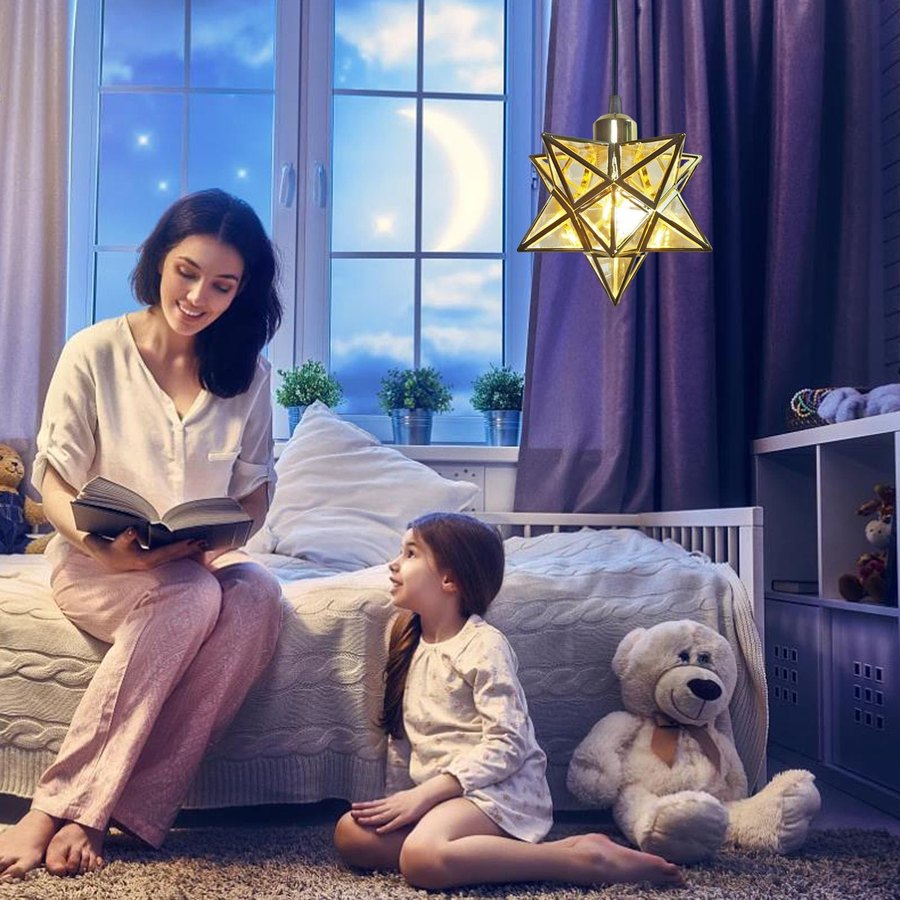
Why a star at Christmas
The short version: the Moravian church in Germany made paper stars as an Advent teaching aid, families hung them in windows to mark the season, and the custom travelled. By the time it reached the United States it was simply part of how a house looks in December. There is no religious requirement and no rule about when it has to come down — which is useful, because the modern version is a light fixture rather than a paper ornament.
What makes the shape work at Christmas specifically is that it is geometric rather than figurative. It does not compete with a nativity, a tree or a wreath, and it reads as festive in a room where a Santa would read as clutter. It also happens to throw light in every direction at once, which is exactly what a dark December afternoon needs.
One practical point up front: ours are plug-in pendants, not battery ornaments. That means they are brighter and far more convincing than a star made of fairy lights, but they do need a ceiling hook and an outlet. Everything below assumes that.
The five best places to hang one indoors
1. In the window
The traditional position, and still the best one if you have a window that faces the street. Hang it so the star sits in the upper third of the glass — from outside it reads as a single bright object floating in the window. An existing curtain-rod bracket, a tension rod, or a small cup hook in the top of the window frame will all take the weight.
2. Over the dining table
December is the month when the dining table gets used most. A star hung low over it, on the warm setting, does more for a dinner than candles do and does not need replacing. This is also the position most people keep after the holidays end.
3. In the entryway
The first thing guests see. A star in a hallway or entry does the job of a wreath without blocking the door, and it lights the room you are actually standing in while you take coats. If your entry has no ceiling light at all, this is the fix — see our entryway pendant guide.
4. Over the mantel
A star above a fireplace fills the dead space above the mantel and throws light up the chimney breast. Hang it high enough that it is clear of anything you put on the mantel itself, and keep the cord behind the garland if you have one.
5. In a stairwell or a two-storey hall
The showpiece position. A star hung at the top of a stairwell is visible from the whole ground floor, and the facet pattern lands on two storeys of wall. Measure the drop carefully — these are the hardest places to reach once installed.
Hanging it near a Christmas tree
People ask this every year, and the answer is that they work well together but not in the same place. Two rules:
- Do not hang the star directly above the tree. It competes with the tree topper and the heat from a bulb sitting that close to dry branches is a bad idea. Put it elsewhere in the room and let the two read as separate objects.
- Keep the cord well away from the tree, the tree skirt and the water reservoir. A real tree drinks a surprising amount in the first week and the stand is often a puddle. Route the cord up to the ceiling and along it to the wall, not down toward the tree.
If you want the star and the tree on the same wall, offset it by at least two or three feet and hang it slightly higher. The effect you want is two lights in one room, not one light behind another.
The window tradition, done indoors
The classic Moravian placement is outdoors under an eave. Ours are indoor-rated only, so do not put one on a porch in the weather — but you can get almost the same effect from inside:
- Hang it in the upper third of the window, close to the glass, so the light reads from the street.
- At night, turn the room lights off behind it. A lit star against a dark room is visible from much further away than one competing with a lit room.
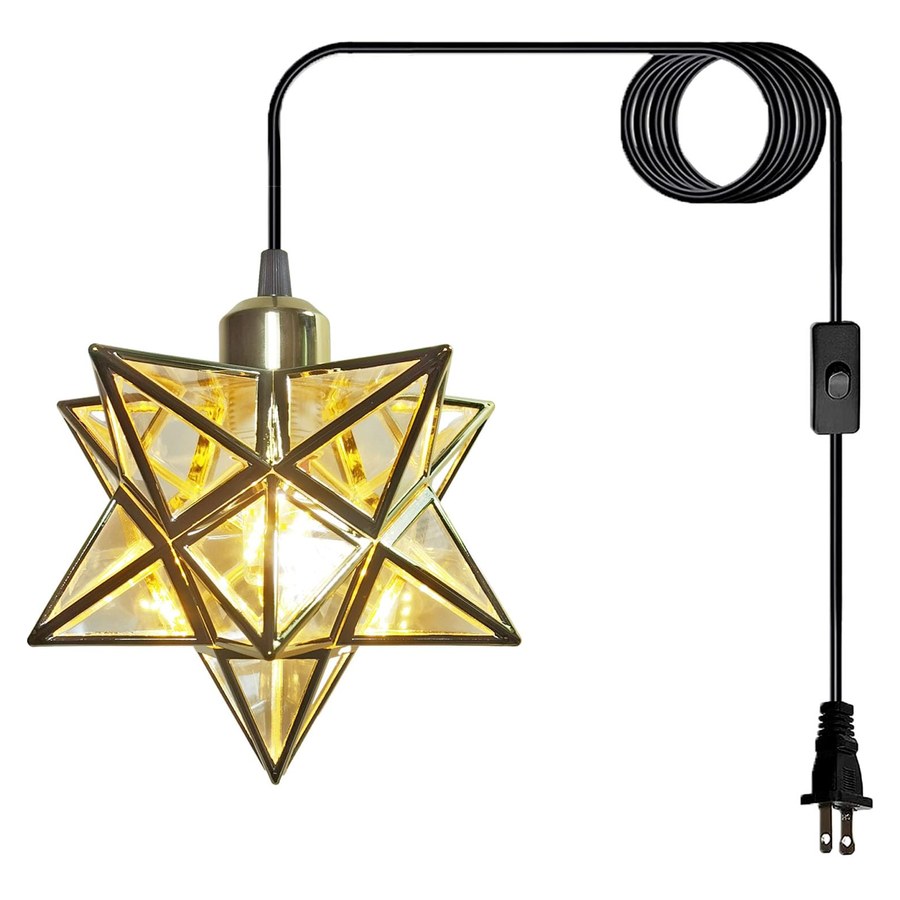
- A gold star is the most traditional choice for a window, because warm light through a warm frame reads as candlelight from outside.
Cord and fire safety around holiday decor
December is when homes add the most electrical load and the most flammable material at the same time. The rules that matter:
- No daisy chains. Plug the star into the wall, or into a surge protector that is not already carrying the tree lights, an inflatable and a heater.
- Keep the cord off the floor and away from the tree skirt, the fireplace and any doorway people use carrying things.
- Nothing within a few feet of an open flame or a space heater. Ours are plastic-framed — they will not shatter, but they will melt.
- Turn it off when you leave the house or go to bed. The switch on the cord makes this one motion instead of a hunt behind the tree.
- Check the cord once when you unpack it each year, and retire the light if you find damage.
- A real tree dries out. Anything with a bulb stays clear of the branches.
Keeping it up after January
This is the argument for buying a proper star pendant rather than a seasonal ornament: a well-made one is not obviously a Christmas object. A 26-point star is a geometry problem rendered in light, and in a room without tinsel it reads as a sculptural fixture.
What makes it work year-round is the finish and the setting:
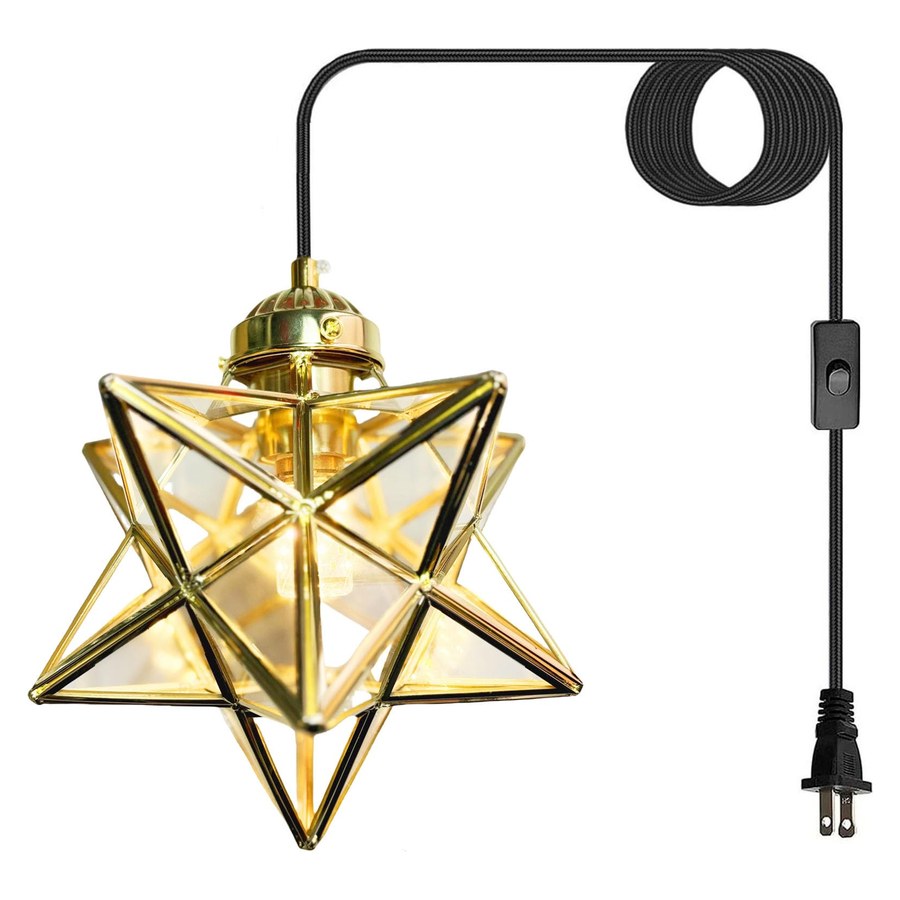
- Gold is the warmest and most traditional, and it carries into February without comment.
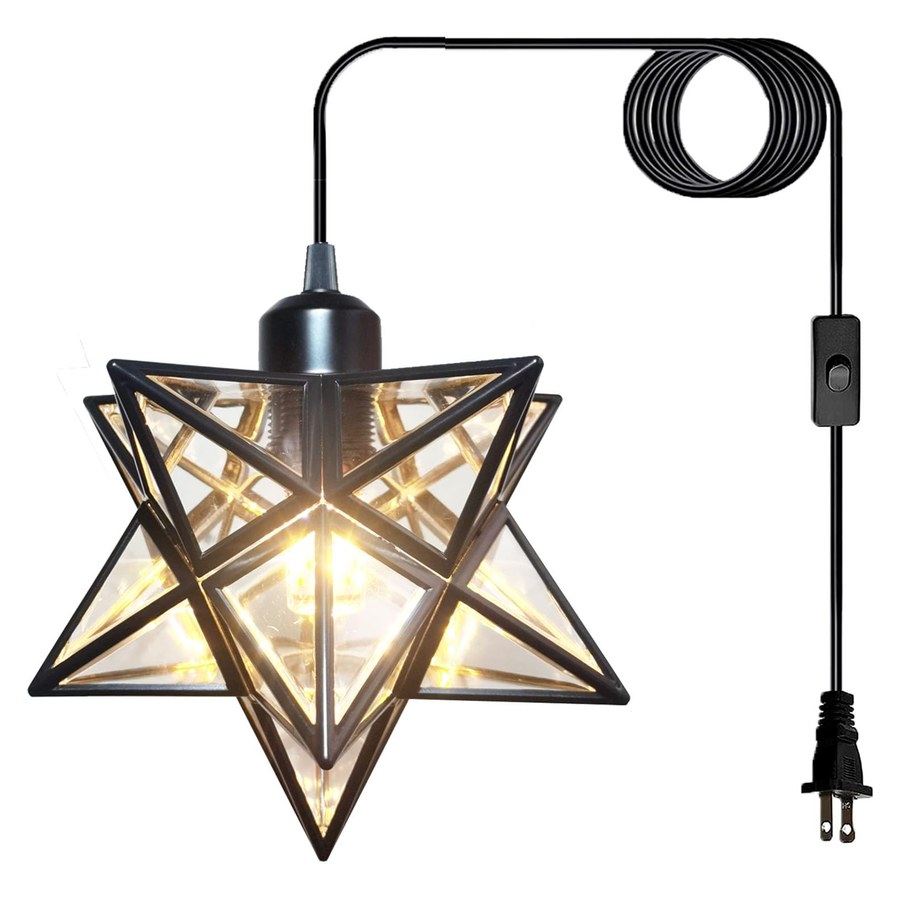
- Black matte or black reads as modern design rather than holiday decor, and is the easiest to leave up.
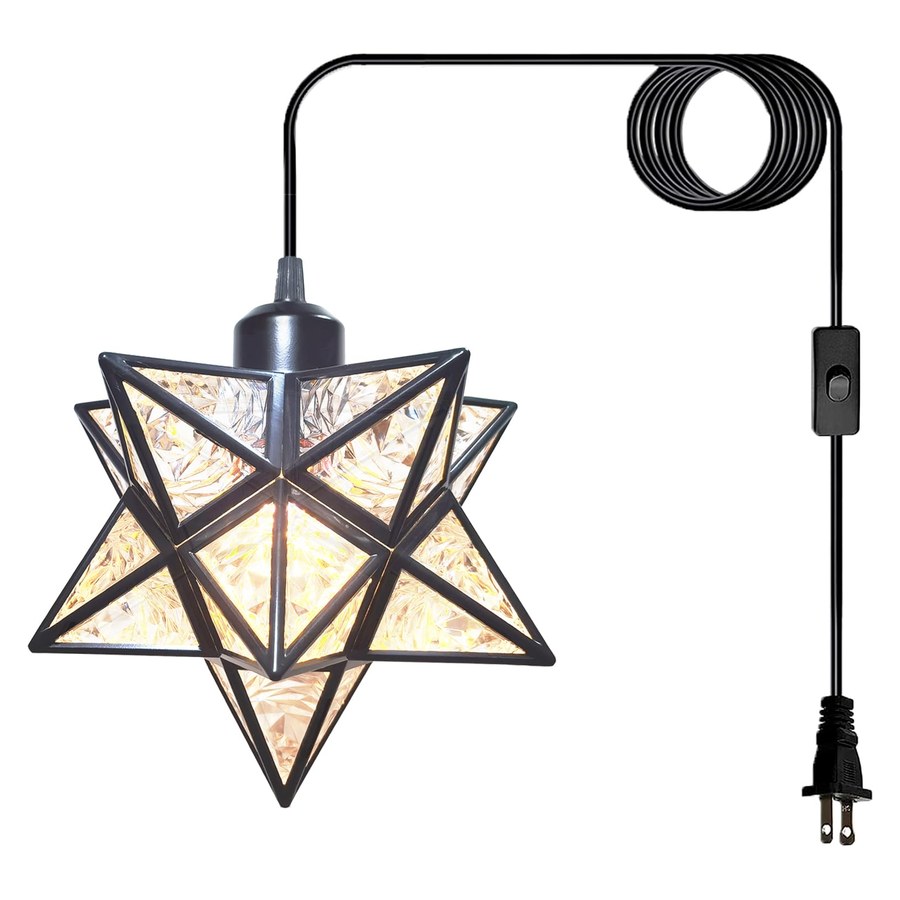
- Brass with seeded glass is a genuine metal-and-glass fixture; nobody reads that as seasonal.
Practically: hang it somewhere you wanted a light anyway — the entry, the dining table, a stairwell — rather than somewhere you only decorate in December. Then Christmas is a setting change, not an installation.
Which finish for the holidays
| If your decor is… | Choose | Why |
|---|---|---|
| Traditional red, green, warm white lights | Gold or textured farmhouse gold | Warmest reading of the shape; sits naturally with brass candlesticks and wood. |
| Scandi, white, paper ornaments, minimal | Black matte | No sheen, so it reads as a silhouette against pale walls — very much the Scandi look. |
| Modern, metallics, cool white lights | Brass & seeded glass | The seeded glass scatters every point into sparkle, which is what makes metallics work. |
| Dark green, black hardware, moody | Black | The frame disappears at night and you are left with pure points of light. |
All four plastic-framed stars weigh about 1.5 lb, which is why a single removable hook is enough. The brass one is heavier and its panels are glass — hang it where it will not be knocked by a ladder in January.
Taking it down and storing it
Every star we make ships with a three-setting E26 LED, cycled from the switch on the cord — bright, soft and warm neutral. Warm neutral is the December setting; it is the one that makes a room feel finished at 5 p.m. when it is already dark.
When the season ends:
- Unplug it, then coil the cord loosely rather than wrapping it tight around the frame.
- Wipe the shade with a dry cloth before it goes away — dust left on a textured surface for ten months is harder to remove later.
- Store it in the box it came in if you still have it. The points are the fragile part.
- Or simply leave it up. That is what most people end up doing.
Free shipping within the US and a 30-day return window, so if the finish is wrong when it arrives, email lightsolutionss@outlook.com and we will sort it out.