Why the entry is worth fixing first
Three reasons, in order of how much they matter:
- You use it every single day. Not weekly like a dining room, not seasonally like a porch. You come through the door in the dark, every night, all year.
- It is the first thing anyone sees. A lit entry reads as a cared-for house. An unlit one reads as a house where the light does not work, even when it does.
- It is small. One fixture transforms it. Doing the same to an open-plan living space takes five.
And the reason it usually has not been fixed: the ceiling has no junction box in the place you would want one, and adding one means opening the ceiling for a room you pass through in eight seconds. A plug-in pendant removes that objection entirely — a hook, an outlet, and you are done.
What size pendant for a hall
Entryways are narrow, and the mistake is going too big. A pendant that would look perfect over a dining table will crowd a hallway and clip tall people in the shoulder.
| Entry type | Pendant size | Notes |
|---|---|---|
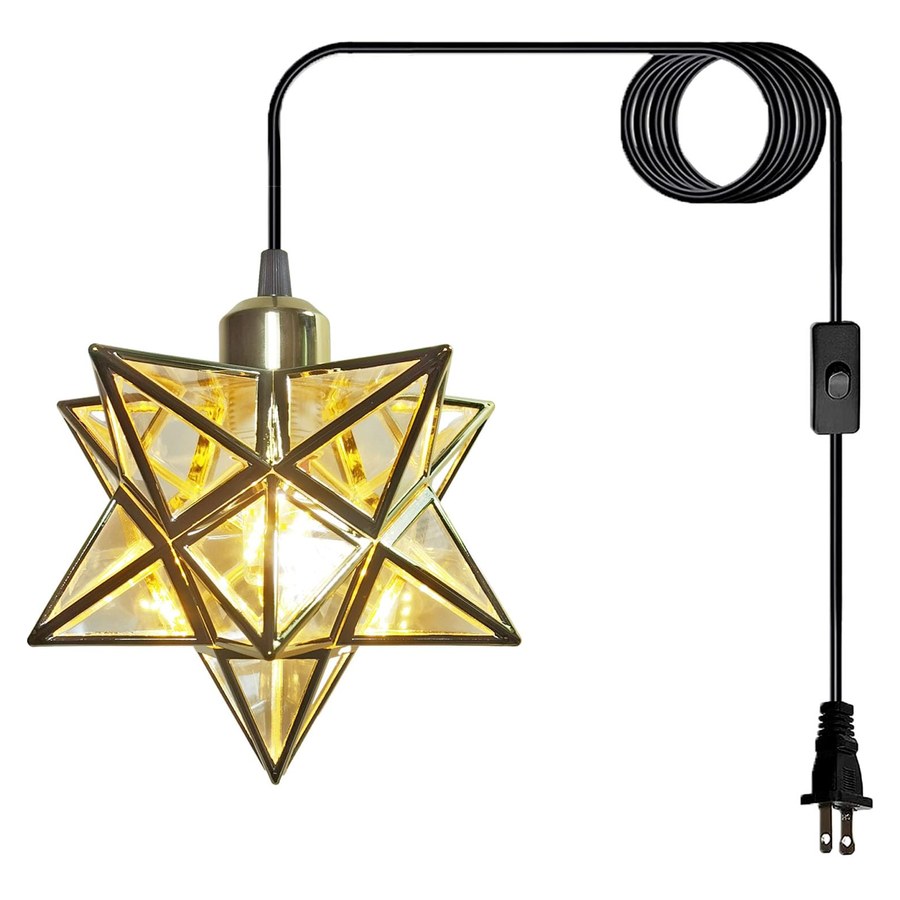
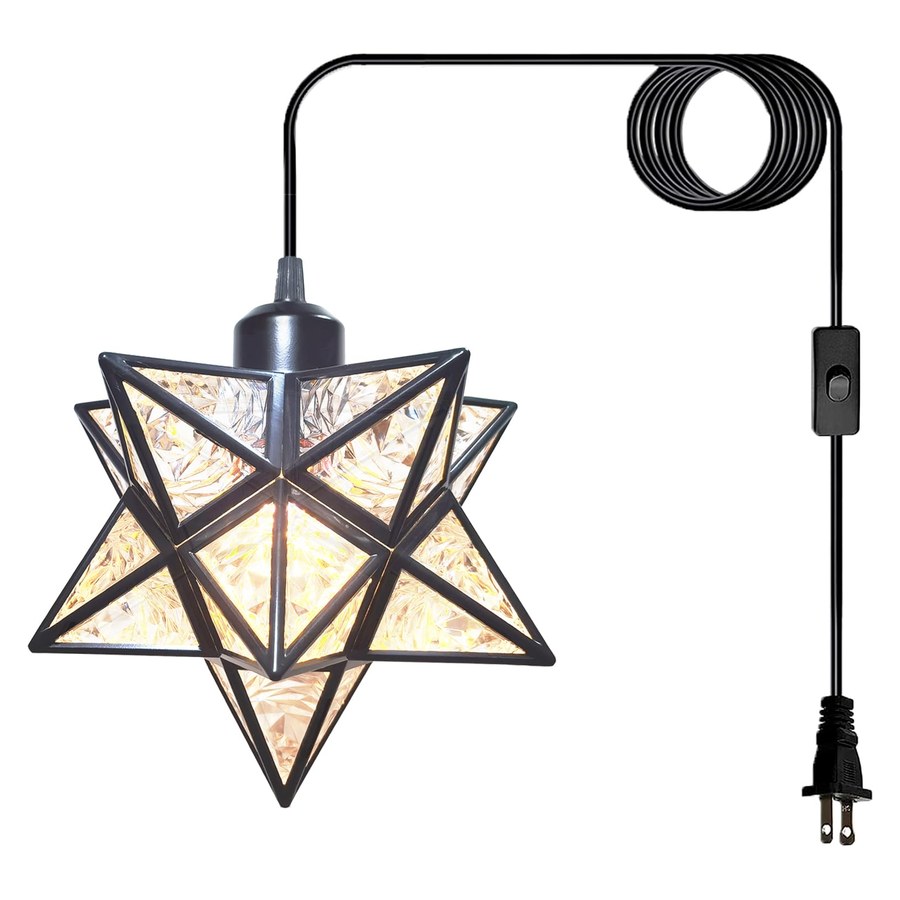
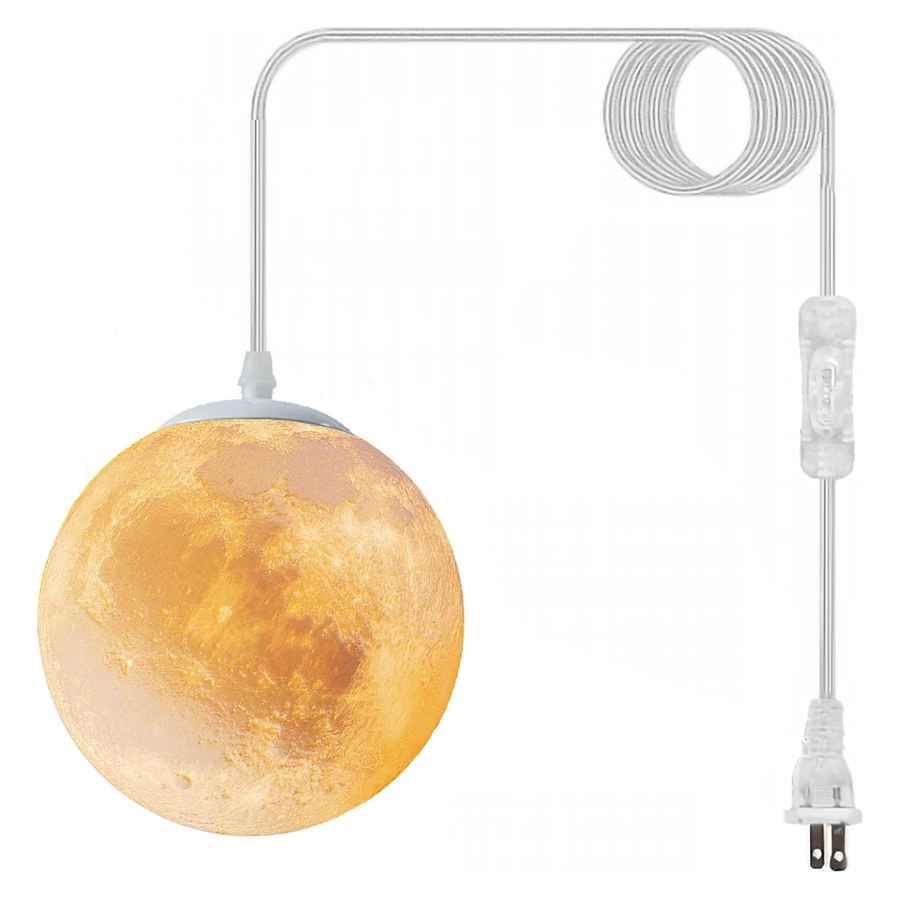
| Narrow hall, under 5 ft wide | 6–8 in | One small pendant, centred. Our 7 in moon and 7.48 in stars sit here. |
| Standard entry, 5–8 ft | 7–10 in | The most common case. One pendant, or two if the hall is long. |
| Wide foyer or two-storey entry | 10–14 in, or a pair | Scale up, or hang two in line down the hall. |
| Long corridor | Two or three small pendants | Space them evenly; do not try to light the whole run with one. |
A useful rule of thumb for width: add the room's length and width in feet, and use that number in inches as the fixture diameter. A 6 × 10 ft entry gives 16 in, which is the maximum — for a hallway, deliberately go under it.
How high to hang it over a walkway
This is the one place where the usual pendant advice does not apply. Over a dining table you hang low, because people are sitting. In an entryway people are standing and walking, and a pendant at 30 in above a floor would be a head injury.
- Minimum clearance: at least 6 ft 6 in between the floor and the bottom of the shade in any walking route. That is the number that matters.
- 8 ft ceilings: hang it close to the ceiling. You do not have room for a drop, and a fixture tight to the ceiling still lights the space fine.
- 9–10 ft ceilings: you can drop it a little for a better look — but stop well above head height. Around 7 ft from the floor is safe and looks intentional.
- Two-storey entry: hang it in the upper volume if you can; it reads as a lantern from the door and you never have to worry about clearance.
- Above a stair landing: the same 6 ft 6 in rule applies to the highest step, not the floor below.
Check it by walking the actual route with the fixture hung, before you clip the cord. It takes twenty seconds and saves the one mistake you cannot un-notice.
Where in the hall, exactly
Centred in the entry, not centred in the hall
Position it over the part of the floor people actually stand on — usually just inside the door — rather than the geometric middle of a long corridor. This is what makes an entry feel lit rather than merely illuminated.
Over the console table
If you have one, a pendant above it does double duty: it lights the surface where keys and post land, and it frames the mirror above. Hang it so the shade clears the tallest thing you put on the table.
In line down a long corridor
Two or three pendants, evenly spaced, hung at the same height. This is the hotel-corridor effect and it works — it turns a passage into a room.
In the stairwell
A pendant at the top of the stairs, visible from the door, does more for a two-storey entry than anything you can put at the bottom.
Cord routing in a narrow space
Entries are tight, which makes cord routing easier in one way and harder in another: there is almost always a wall within reach, but there is also less room to hide anything.
- Go up and along the ceiling to the nearest wall, then down the wall to the outlet. In a hall this is usually two or three feet of horizontal run — the shortest cord route of any room in the house.
- Clip it every 12–18 in and at every corner. Unclipped cord in a hallway is the version that looks improvised.
- Run it above the door frame if the outlet is on the far side, rather than across the opening.
- Use the door-frame shadow line. A cord running vertically down the inside edge of a door frame is almost invisible.
- Never across the floor, never under a hallway runner, never across the path from the door to the stairs.
- Plug into a hall outlet or a surge protector tucked behind the console. Do not share it with a space heater in winter, which is exactly what hall outlets get used for.
Full routing detail, including which clips hold on a textured ceiling, is in our no-wiring pendant guide.
The switch problem, solved
The obvious objection to a plug-in pendant in an entryway is that when you come home in the dark, you want to hit a switch by the door — not reach up to a cord.
Three ways to deal with it:
- Leave it on a smart plug or an outlet timer. Set it to come on at dusk and off at bedtime. You never touch it, and the house is never dark when you get home. This is the single best answer and it costs very little.
- Use the in-line switch as a dimmer of last resort — ours cycles through bright, soft and warm neutral, so even at the cord you are choosing a mood rather than on/off.
- Plug it into a switched outlet if your hall has one — many do, wired for a lamp that was never bought. Check by flipping the switch with a phone charger in the outlet.
Getting the light-left-on look
The effect worth aiming for in an entry is not brightness. It is the impression that someone is home and the light was left on for you. Two things produce it:
- Warm, not bright. Use the warm neutral setting in the evening. A bright cool light in a hallway reads as a corridor in an office building.
- Light on a surface, not into eyes. A pendant over a console table, or a moon whose glow falls on the wall behind it, gives you the lit-room feeling without any glare as you come through the door.
If you have not chosen a shape yet, our moon lamp buying guide covers size, brightness and colour temperature in detail. In short: a 7-inch moon pendant is very good at this — the cratered surface diffuses rather than beams, so it glows instead of glaring. A gold star does the opposite in a useful way: it throws points of light up and down the hall, which is what makes a narrow entry feel taller.
Small and awkward entries
Renting? The renter's guide covers removable hooks that will not cost you a deposit — which matters in a hallway, where the hook is right by the door everyone sees.
If your "entryway" is three feet of tile inside the front door, one pendant hung close to the ceiling and slightly off-centre is the whole answer. Do not try to light the stairwell and the door with one fixture; put the pendant at the door and use a small warm light further in.
If the only outlet is on the wrong wall, move the hook rather than extending the cord — a hook two feet nearer the outlet wall is invisible, and an extension cord across a hallway is not.
All of our plug-in pendants are indoor-rated for dry areas, which covers an entry and a covered, sheltered porch but not an exposed one. Free US shipping, a 30-day return window and a one-year warranty. Sizing questions? Send a photo to lightsolutionss@outlook.com and we will answer within one business day.