Why sloped ceilings are hard — and why plug-in is easier
Three separate problems get lumped together under "vaulted ceiling":
- There is no flat mounting surface. A hardwired canopy is a flat disc designed to sit flush against a flat ceiling. On a 30° slope it touches at one edge and gapes at the other. The fix is an angled adapter or a sloped-ceiling canopy, which is a part you have to buy, match to the slope, and fit.
- The junction box is in the wrong place. Builders put the box at the peak or wherever the run was easiest, which is rarely where the light should be. Moving it means opening the ceiling.
- Everything is higher and further away. Getting to the ridge needs a taller ladder than most people own, and the distance from the hook to an outlet is longer than on a flat ceiling.
A plug-in pendant removes problems one and two entirely. The canopy is replaced by a hook, and a hook goes anywhere. The shade hangs from a flexible cord, so it hangs plumb — straight down under gravity — regardless of whether the ceiling above it is at 0° or 45°. The angle stops mattering. Only problem three, the height, remains, and it is a ladder problem rather than an electrical one.
What you are working with: ridge, slope, and where the joists run
Before you buy anything, work out which of three ceilings you have, because the fixing method depends on it:
- Cathedral / vaulted with exposed ridge beam. Best case. The ridge beam is structural, it is visible, and a hook into it will hold far more than a pendant weighs.
- Vaulted drywall (no exposed beam). The slope is drywall on rafters or on furring strips over the roof structure. Joists run up the slope, not across it, so a stud finder swept horizontally will miss them — sweep vertically up the slope instead.
- Shed / single-pitch slope (attic conversion, addition). Same as above, with one flat high wall and one flat low wall. The high wall is your friend: it is flat, it is reachable, and it is where the swag anchor goes.
If you cannot find structure and you do not want to make holes, the alternative is a swag from the nearest flat wall — see below. It is the solution most people end up with, and it looks better than a hook in the middle of a big empty slope. The general hanging sequence is the same as on a flat ceiling; the full step-by-step is in how to hang a plug-in pendant.
Putting a hook into a sloped ceiling
Two things differ from a flat ceiling: the load is partly shear rather than purely vertical, and you are working overhead at an awkward angle.
If you can hit structure
- Find the member with a stud finder swept up the slope, then confirm with a small pilot hole and a thin nail.
- Use a screw hook with a coarse thread, not a fine one — coarse threads hold far better in softwood rafters.
- Drill a pilot hole slightly smaller than the hook's core. Do not rely on the hook to self-tap into a rafter; you risk splitting it.
- Screw it in until the shank is fully seated and the open side of the hook faces downhill — so any pull on the cord cannot walk the cord out of the hook.
- Test with something three times the fixture weight before the pendant goes up.
If you cannot hit structure
Use a proper hollow-wall anchor rated for the load — not a screw into drywall. On a slope, anchors in drywall over furring strips have an air gap behind them, which changes how the anchor sets; use a toggle-style anchor that clamps on the far side rather than an expansion anchor.
Adhesive hooks on a slope
Generally no. A removable adhesive hook relies on full surface contact and a pure vertical pull; a slope gives you neither reliably, and the failure mode is a falling glass shade. On a shallow pitch (under about 10°) with a smooth painted surface, a hook rated well above the load can work, but test it with a bottle of water for a full day first.
The swag: the answer when the outlet is nowhere near
Swathes of vaulted-ceiling advice assume the pendant has to hang from the peak. It does not. A swag is simply a cord that runs from a high anchor point to a lower one along the wall, with the shade hanging in the middle of the run. It is how people hung pendant lamps for decades before junction boxes were everywhere, and on a sloped ceiling it is usually the cleanest answer.
- Anchor high on the flat wall at the top of the slope, as close to the ceiling line as you can get.
- Anchor low partway down the same wall, or at the point where the cord turns toward the outlet.
- The shade hangs in the middle of the run, pulled out into the room by its own weight.
- The cord then continues down the wall to the outlet — the same wall you anchored to, so the whole run is against one surface.
Why this wins on a vault: the anchors go into a flat vertical wall, which is easy to reach, easy to find structure in, and takes a normal hook. The ceiling stays untouched. And visually a swag across a sloped wall reads as intentional — it echoes the angle of the roof rather than fighting it.
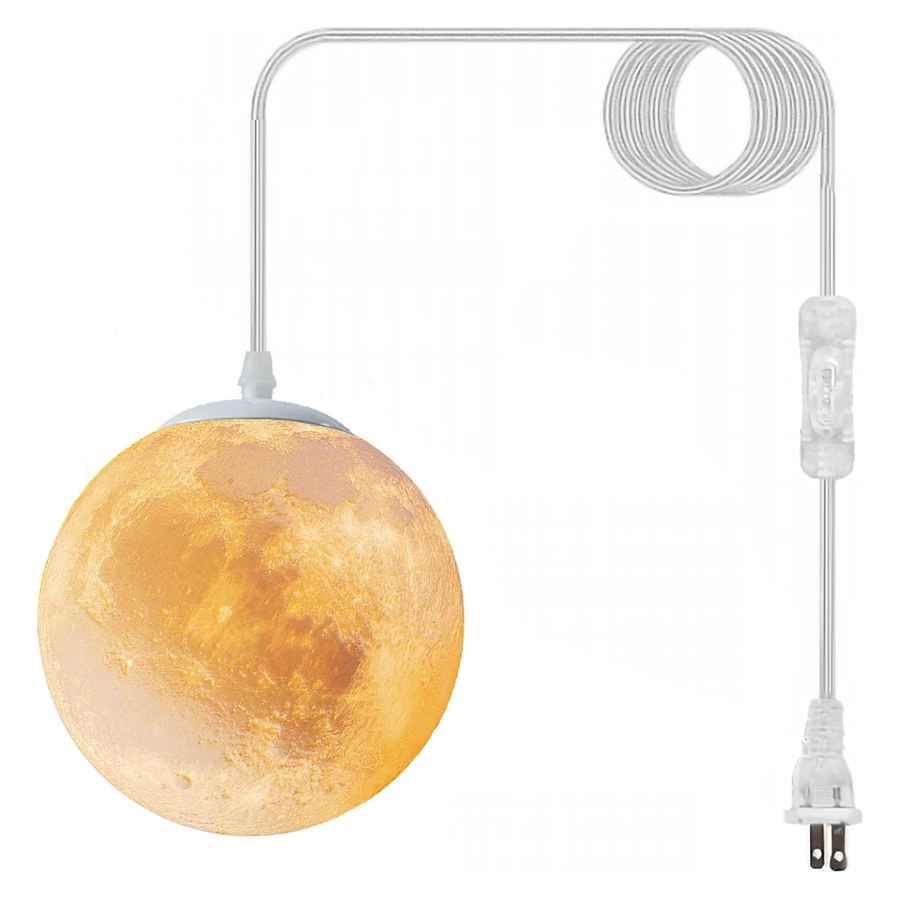
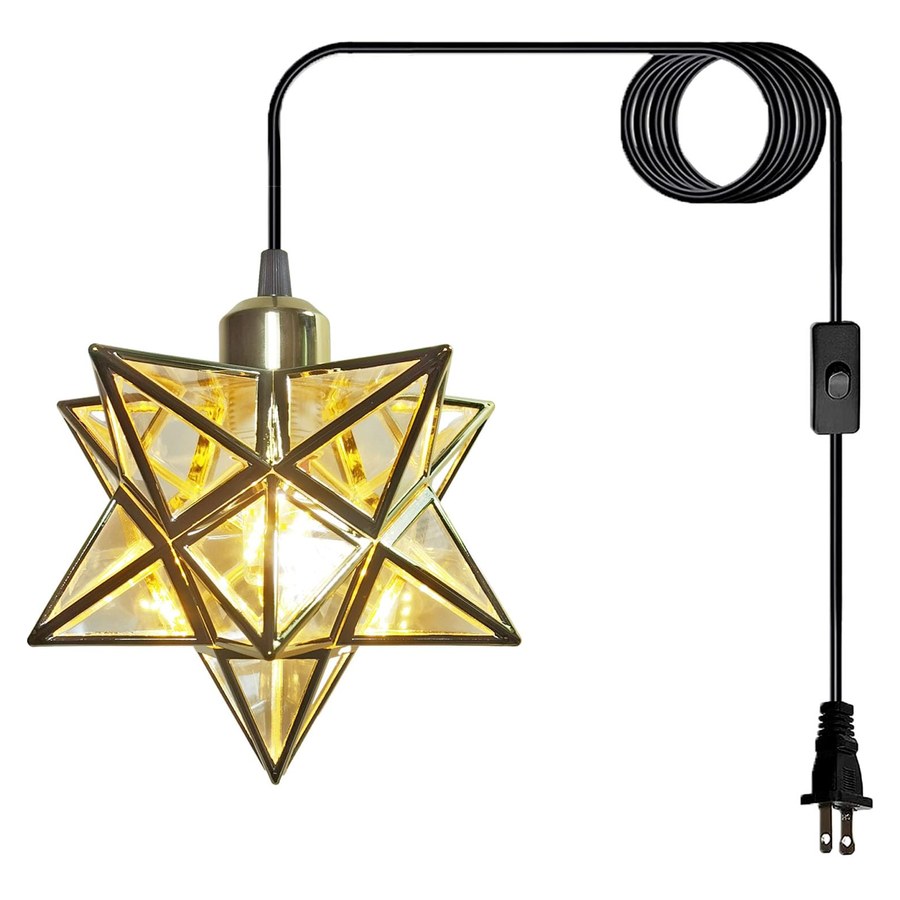
The one constraint is cord length. Ours are 16.4 ft on the moon and 16.5 ft on most stars, which is enough for a swag across a typical 12–14 ft slope plus the drop to an outlet. Measure the run along the route, not in a straight line.
Getting the drop height right with no flat reference
On a flat ceiling you measure down from the ceiling. On a slope there is no single ceiling height, so measure from the thing underneath instead:
| Situation | Where the bottom of the shade goes |
|---|---|
| Over a table under a vault | 30–36 in above the tabletop. Ignore the ceiling entirely. |
| Over a kitchen island | 30–36 in above the counter. |
| In the middle of a vaulted room | Bottom of shade no lower than 6 ft 6 in above the floor, and high enough that it is not in the sightline from the doorway. |
| Over a stair that runs under the slope | At least 6 ft 6 in above the highest step you stand on — measured from the step, not the floor below. |
There is a temptation in a tall room to hang the pendant very low to "bring the ceiling down". Do it in moderation: dropping below 30 in over a table makes conversation across it awkward, and the light pool gets small and hot. Drop it to the rule, not past it.
One vault-specific trick: if the room is genuinely cathedral-height, hang two pendants at different drops rather than one at a very long drop. Two fixtures at staggered heights give the room the layered look people are actually after, and neither has to hang absurdly low.
Routing the cord down a slope
The cord run is longer and more visible than on a flat ceiling, so it deserves more care:
- Run along the slope, not across it. A cord that follows the ceiling's own line disappears into it. A cord cutting diagonally across a big empty slope is the most visible thing in the room.
- Get it into the ceiling/wall junction as fast as you can. From the hook, the shortest path to the wall line is straight down the slope — that line is already there architecturally.
- Clip every 12–18 in, and clip at the corner where the slope meets the wall. On a slope, gravity pulls the cord toward the low end, so unclipped cord migrates.
- Never drape it over the ridge beam if you can avoid it — the high point is the most visible one in the room.
- No extension cords. If the run does not reach, move the anchor nearer the outlet wall and increase the swag instead.
Which of our lights suits a vaulted room
- The moon pendant — the natural fit. It is a solid glowing sphere, it reads clearly from across a big room, and the three settings let you go bright for the room and warm for the evening. Works hung from the ridge or swagged from a wall.
- A gold Moravian star — better if the vault is over a dining table or an island, where the star is seen close up as well as from across the room. Gold holds an outline against a dark vaulted ceiling; matte black tends to vanish up there.
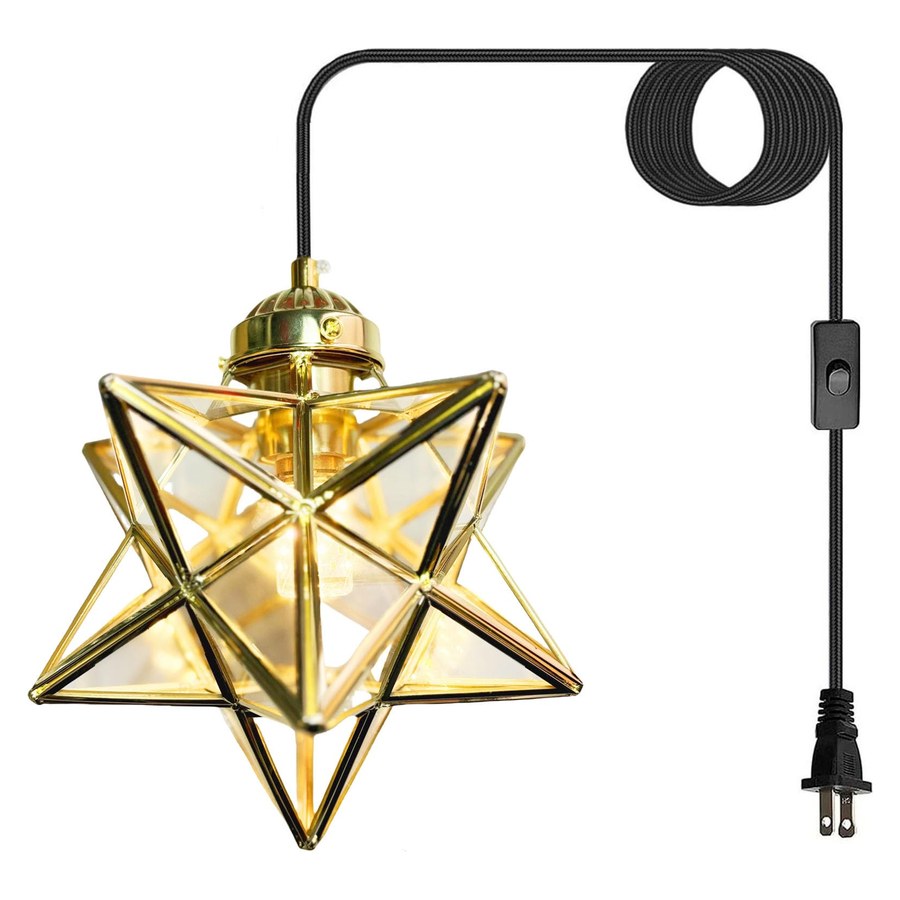
- The brass star with seeded glass — the choice for a vault with real architectural ambition. The glass panels throw light in every direction, which is what a tall volume needs. It is heavier, so put the hook into structure, not an anchor.
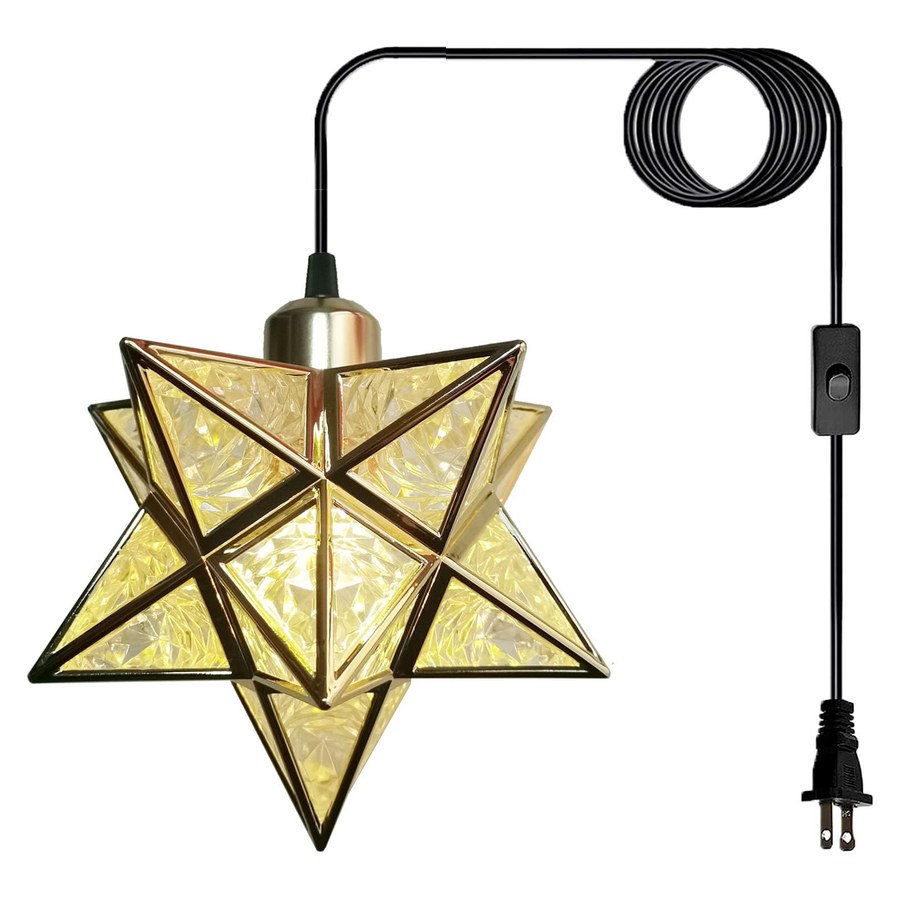
- The farmhouse gold star — the pick for a vaulted kitchen with an island, where you want texture rather than shine.
All of them are plug-in, which is the actual point: on a vaulted ceiling the difference between "possible this weekend" and "needs a contractor and a permit" is almost entirely whether the fixture has a plug on the end.
When you should call someone instead
Be honest about three cases:
- The only viable anchor point is more than about 14 ft up and you would need to lean a ladder against a slope. That is a fall, not a project.
- You want several fixtures on one switch in a great room. That genuinely is hardwired territory.
- The ceiling is plaster over lath on an old roof and you cannot find anything solid. Anchors behave unpredictably in lath, and patching a sloped plaster ceiling is not a DIY job.
Everything else — the hook, the swag, the clips, the drop height — is an afternoon with a stepladder. Free shipping within the US, a 30-day return window and a one-year replacement warranty. If you want a second opinion on your specific slope, send a photo to lightsolutionss@outlook.com and we will tell you whether a hook or a swag is the right call.