First: check whether you really have no box
Before you conclude the ceiling is empty, do three things, because a surprising number of "no box" ceilings turn out to have one:
- Look for a blank plate. Builders cap unused ceiling boxes with a flat round cover, often painted over. If you find one, you already have wiring there and every option below gets easier.
- Tap and listen. A hollow spot in a regular grid is often a joist bay with a box in it. A solid ring suggests a fixture was removed and the opening patched.
- Check the switch. A wall switch that does nothing is the giveaway: it was wired to a ceiling box that is now covered. Turn the breaker off and remove the blank plate to confirm.
If you genuinely have nothing — and over a dining table in a house built after 1990, you often genuinely have nothing — read on.
Option 1 — A plug-in pendant on a hook
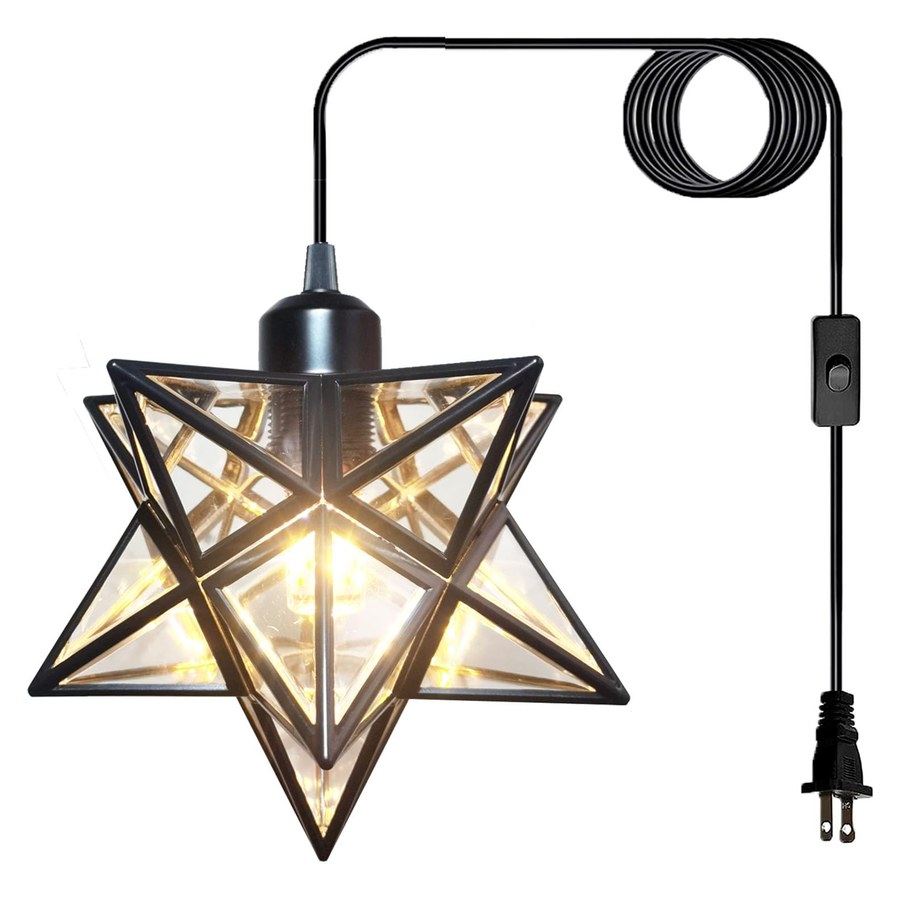
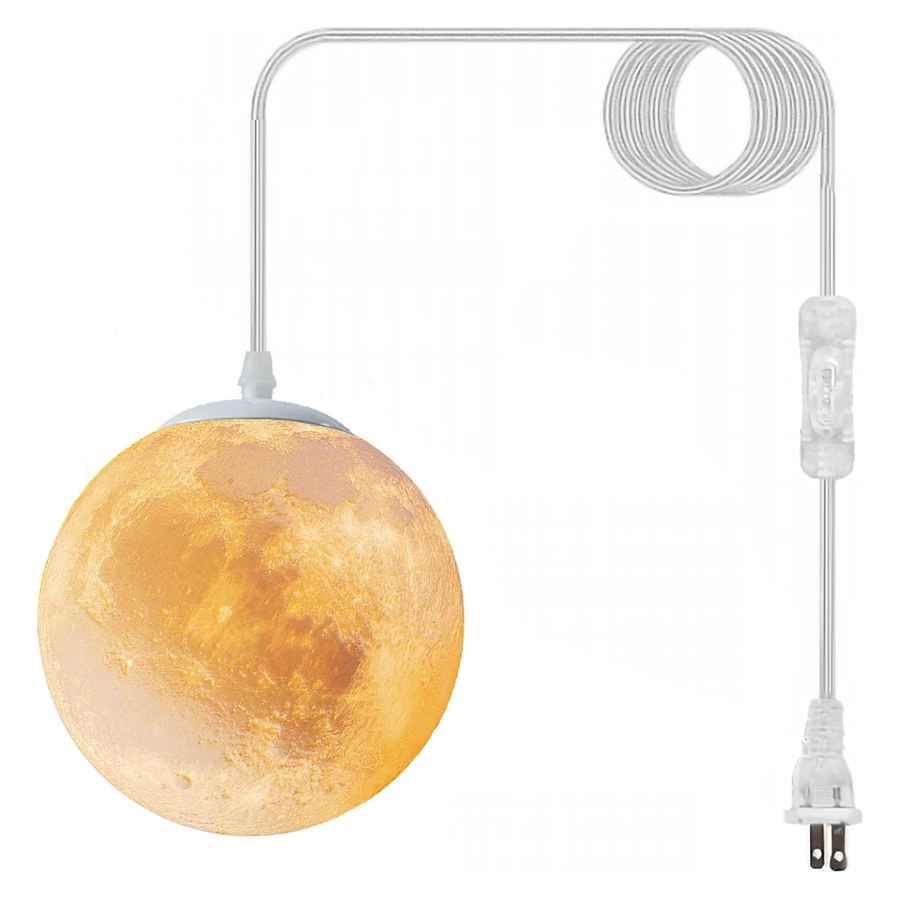
The fixture ends in a standard US plug instead of a bare cable. It hangs from a hook you put in the ceiling and draws power from a wall outlet. Nothing in your home's electrical system is touched, spliced or opened.
What it involves: one hook in the ceiling, one outlet, and a cord routed along the ceiling and down the wall. About ten minutes with a stepladder.
What it looks like: there is a cord. Run up the wall and along the ceiling with adhesive clips every 12–18 in, a transparent cord against a white ceiling is very hard to see from standing height. Alternatively, swag it deliberately between two hooks and it reads as a design choice. Our no-wiring pendant guide covers the routing in detail.
What it costs in effort: almost nothing. No permit, no electrician, no patching.
Can you take it with you: yes. This is the only option on the list that is fully portable.
The catch: you need an outlet within the cord run — 16.4 ft on our moon pendants, 16.5 ft on most stars — and the cord has to go somewhere. In a room with a clear wall route this is a non-issue; in the middle of an open-plan space it takes more thought.
Option 2 — Swag it from an existing box nearby
If there is a ceiling box somewhere in the room — over the hallway, near the wall, wherever the builder put it — a plug-in pendant can hang from a hook in the middle of the room while the cord runs to that wall. This is what "swag" means, and it is the oldest trick on this list.
What it involves: two or three ceiling hooks, and a cord run you are willing to see.
What it looks like: a deliberate curve of cord from the hook to the wall. Done on purpose with a hook at each end it looks intentional; done by accident it looks like a mistake. Use a decorative chain cover or a cord sleeve if you want it to read as hardware.
The catch: you are hanging from a hook, not from the box, so the fixture weight is carried by the hook — a hollow wall anchor will not do. Find a joist, or use a hook rated well above the fixture weight.
Option 3 — A retrofit canopy over an existing box
Also called a "no-box ceiling adapter" or a swag canopy kit: a shallow plate that mounts to the ceiling surface and lets a hardwired-style pendant hang from it, with the cord running to a nearby outlet. It gives you the look of a hardwired pendant with a cord instead of wiring.
What it involves: mounting a plate to the ceiling with anchors or a joist screw, plus the same cord routing as option 1.
What it looks like: the cleanest corded option, because the plate hides the hook and the cord exits neatly at the side. If you want a pendant look without a visible hook, this is it.
The catch: more parts, more cost, and it is still not hiding the cord to the wall. It also involves putting screws in your ceiling, which matters in a rental.
Option 4 — Cut in a new ceiling box
The real thing: a new junction box in the ceiling, a cable fished from a nearby source, drywall cut and patched, then painted.
What it involves: a licensed electrician in most jurisdictions, plus a drywall patch and a paint touch-up. In some areas this needs a permit.
What it looks like: perfect. No cord, no hook, nothing on the ceiling but the canopy. If you have just renovated or the ceiling is being opened anyway for another reason, do this — the marginal cost collapses when someone is already up there.
The catch: it is the expensive option by a wide margin, it is not reversible, and it adds nothing when you sell beyond what a plug-in pendant would have done cosmetically. Do it when the ceiling is already open, not as a standalone project for one light.
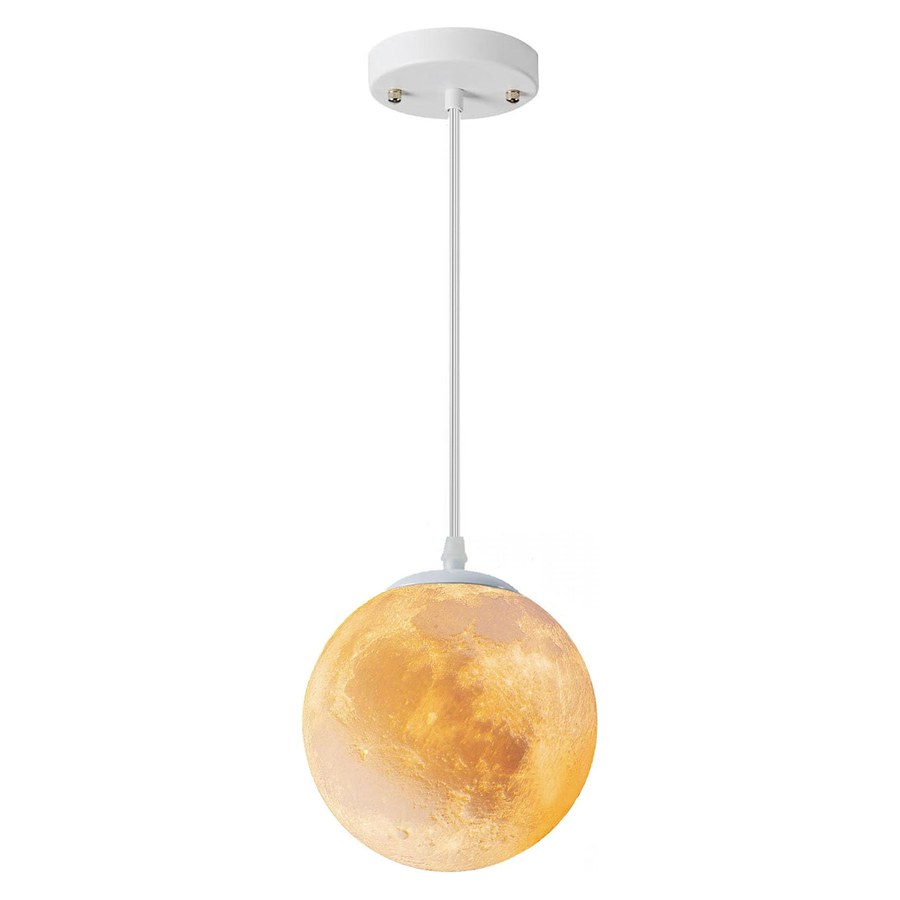
If you go this route, the hardwired moon ceiling light mounts to a standard ceiling box and has no cord at all. We recommend a licensed electrician for the install.
Side by side
| Plug-in on a hook | Swag from nearby box | Retrofit canopy | New ceiling box | |
|---|---|---|---|---|
| Electrician | No | No | No | Yes |
| Drywall work | None | None | Anchors only | Cut, patch, paint |
| Cord visible | Yes, routable | Yes, on purpose | Yes, from plate | No |
| Reversible | Yes | Yes | Mostly | No |
| Portable when you move | Yes | Yes | Yes | No |
| Best for | Almost everyone | A box exists nearby | You hate the hook look | Renovation, or forever home |
If you rent
Option 1, and specifically a plug-in pendant on a removable adhesive hook rated for several times the fixture weight. Our plastic-framed stars weigh about 1.5 lb and the moon about the same, so a hook rated for 5 lb or more has a large margin.
- Respect the cure time on the packet — usually 24 hours before you hang anything.
- Test it by hanging a bottle of water from the hook for a day before the light goes up.
- Adhesive holds well on smooth painted ceilings and poorly on popcorn texture or fresh paint.
- Take the hook down with dental floss behind the pad rather than pulling it, and the paint comes with it far less often.
- Ask before you screw anything into a ceiling you do not own.
More on this in the renter's guide.
Measure the route, not the distance
The mistake people make with plug-in pendants is measuring the straight line from the ceiling to the outlet and concluding the cord is plenty long enough. What has to fit is the route: up from the shade to the hook, along the ceiling to the wall, down the wall to the outlet — plus a bit of slack at each end. That is routinely 1.5 to 2 times the straight-line distance.
If it is tight, move the hook nearer the outlet wall and let the cord swag across the gap, or pick a hanging point closer to a wall. Do not solve it with an extension cord; that is a trip hazard and a permanent-looking fix for a temporary problem.
Free shipping within the US, a 30-day return window and a one-year replacement warranty. Not sure which option fits your room? Email lightsolutionss@outlook.com with a photo of the ceiling and we will tell you straight.